
The Missing Link in the Modern Bohemian Interior
For too long, the Bohemian aesthetic has been pigeonholed into a narrow corridor of macramé, jute rugs, and an endless parade of potted monsteras. While there is an undeniable charm in the 'more-is-more' philosophy of boho-chic, the style often falls into a predictable trap: it becomes visually heavy. In the pursuit of 'earthy' and 'authentic,' many rooms end up feeling cluttered rather than curated. I would argue that the missing ingredient—the element that saves a Bohemian room from looking like a high-end garage sale—is the structured elegance of Venetian glass.
Venetian glass, particularly from the furnaces of Murano, offers a sharp, sophisticated contrast to the rough textures typical of Bohemian design. It provides a necessary tension. When you place a hand-blown, gold-flecked glass vase atop a raw wooden table, you aren't just decorating; you are creating a dialogue between the elemental and the refined. This is where the soul of a room truly lives.
The Counter-Balance to Bohemian Chaos
Bohemian design is inherently maximalist. It thrives on layers of textiles, patterns, and global artifacts. However, without a focal point that commands respect through its craftsmanship, these layers can bleed into one another until the room loses its definition. Venetian glass acts as a visual anchor. Its clarity and light-refracting properties break up the 'crustiness' of organic fibers and matte surfaces.
Think about the typical boho palette: terracotta, sage, mustard, and deep ochre. These are beautiful, grounded colors, but they don't move. They absorb light. Venetian glass, on the other hand, captures and manipulates light. A single piece of Sommerso glass, with its layers of suspended color, introduces a liquid-like movement into a space that might otherwise feel static. It isn't just an accessory; it is a tool for illumination.
Why Texture Alone Isn’t Enough
The mistake many decorators make is assuming that more texture equals more depth. That isn't necessarily true. Depth is created through contrast. If every surface in your room is 'tactile'—think wool blankets, rattan chairs, and clay pots—the eye has nowhere to rest. The smooth, unapologetic gloss of Murano glass provides that rest. It is the 'clean' note in a complex chord. By introducing a material that is born of fire and precision, you elevate the surrounding organic materials. The jute looks more intentional, and the velvet looks more luxurious simply because they are sitting next to something so exquisitely finished.
Curating the Contrast: How to Integrate Glass Without Losing the Vibe
Integrating Venetian glass into a Bohemian space doesn't mean you have to turn your home into a formal museum. It is about strategic placement and a commitment to quality over quantity. If you want to move beyond the 'fast-decor' look, consider these approaches:
- The Chandelier Pivot: Replace a standard wicker pendant light with a vintage Venetian glass chandelier. The juxtaposition of a crystalline, ornate fixture against a backdrop of plants and tapestries is the hallmark of a truly sophisticated interior.
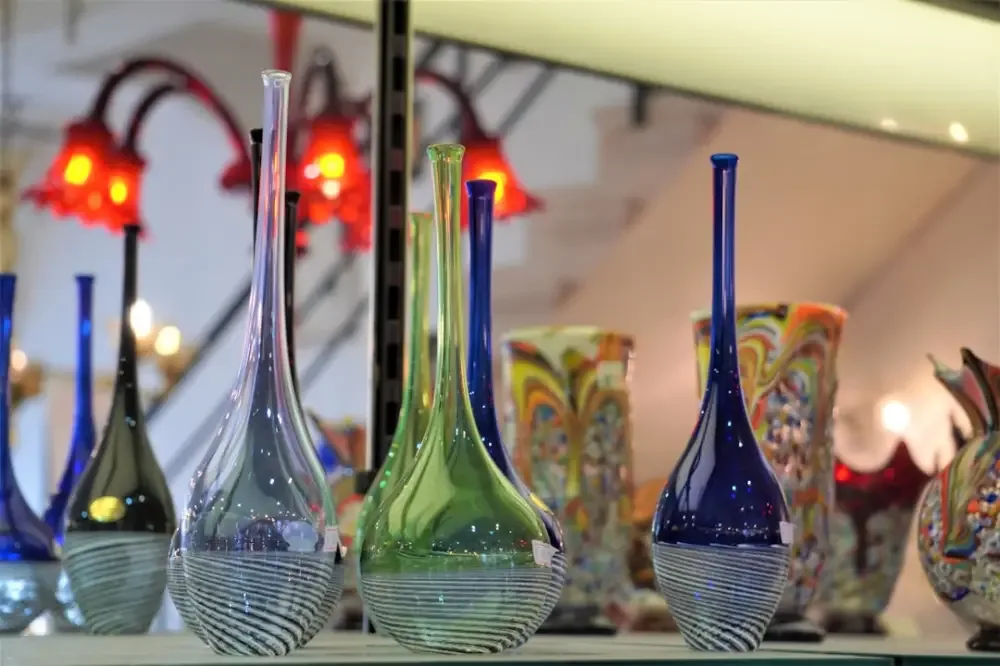
- Vessel Groupings: Instead of five different ceramic pots, try a trio of Venetian glass vases in varying heights. Choose colors that pull from your textiles—perhaps a deep amber or a vibrant turquoise—to create a cohesive but elevated look.
- The Art of the Paperweight: For smaller spaces or bookshelves, Millefiori paperweights offer a burst of intricate detail that rewards close inspection, mirroring the 'collected over time' ethos of the Bohemian lifestyle.
- Reflective Surfaces: A Venetian glass mirror, with its characteristic etched details and floral motifs, can make a small, textile-heavy room feel twice as large and significantly brighter.
Moving Beyond the Flea Market Aesthetic
There is a fine line between a room that feels 'lived-in' and a room that feels 'undone.' The reality is that many Bohemian spaces lack a sense of permanence. Because the style relies heavily on trends like 'shabby chic' or 'desert modernism,' it can feel fleeting. Venetian glass, however, is timeless. It carries with it centuries of Italian history and the breath of master artisans. When you introduce it into a boho setting, you are anchoring the room in a legacy of craftsmanship.
I believe that the most successful Bohemian rooms are those that embrace a 'high-low' philosophy. You can have the vintage rug you found at a swap meet, and you can have the DIY pallet bed, but you must have something that feels precious. Venetian glass is that 'precious' element. It signals that the inhabitant of the space values artistry as much as they value comfort.
Final Thoughts: The Soul of the Room
Ultimately, a Bohemian room is supposed to be a reflection of a life well-traveled and a mind that appreciates beauty in all its forms. To exclude the refined elegance of Venetian glass is to ignore one of the most vibrant chapters in the history of decorative arts. It isn't about being 'fancy' for the sake of it; it is about balance. It is about realizing that for every rough edge, there should be a smooth one, and for every muted tone, there should be a spark of crystalline light. If you want your Bohemian room to truly sing, stop looking for more textiles and start looking for the glass that will finally bring it all together.